


Quick Summary
- Heavy, prominent eyebags convey a tired and angry look
- Common causes of eyebags include aging, protrusion of orbital fat and bony socket loss (especially in East Asians). Eyebags are often accentuated by the tear trough, which is a linear depression just below the eyebag that extends into the cheek. The eyebag forms a bulge, and the tear trough forms a depression, leading to an irregular contour extending from the eyelash down to the cheek.
- In early cases, eyebags may be camouflaged by performing filler injections or fat grafting to the lower orbital rim
- In moderate to severe cases, eyebag surgery (lower blepharoplasty) addresses the eyebag and the tear trough. It restores a refreshed appearance by reducing puffiness, tightening loose skin, and recreating a smooth contour running between the eyelash and the cheek.
- Eyebag removal can be done via a transconjunctival (“scarless” internal incision) approach or through an external skin incision. The eyebags may be excised, or may be shifted downwards to fill the tear trough hollow.
The Lower Eyelid Aesthetic: A Brief History
In Ancient Mesopotamia and Egypt, eye makeup was worn by both men and women as a means of beautification as well as religious beliefs. Egyptians ground malachite (copper ore) to create green pigments for their lids and applied kohl (a mixture of soot, galena and other minerals) to accentuate the almond shape of the eye. Roman nobility crushed precious stones such as lapis lazuli to paint their eyelids in various shades of blue and green. As beauty trends shifted over the ages, bare eyelids became popular during the Middle Ages and the Victorian Era. Eyeshadow experienced a resurgence in the 1910s due to its projection by beauty pioneers like Elizabeth Arden. With the rise of digital photography and social media in the modern era, the eyelid aesthetic has received more focus than ever historically.
What Defines Aesthetic Lower Eyelids?
Smooth and youthful lower eyelids are hallmarks to a refreshed appearance that comprise of:
- Taut lower eyelid skin without wrinkles or droopiness, at rest and when smiling
- Smooth and uninterrupted transition across the eyelid down into the cheek. From the side view, there should be a smooth convex curve from the eyelash to the mouth
- The absence of the tear trough depression
- Tonal radiance with no pigmentation or dark circles
What are the aging changes in the lower eyelid?
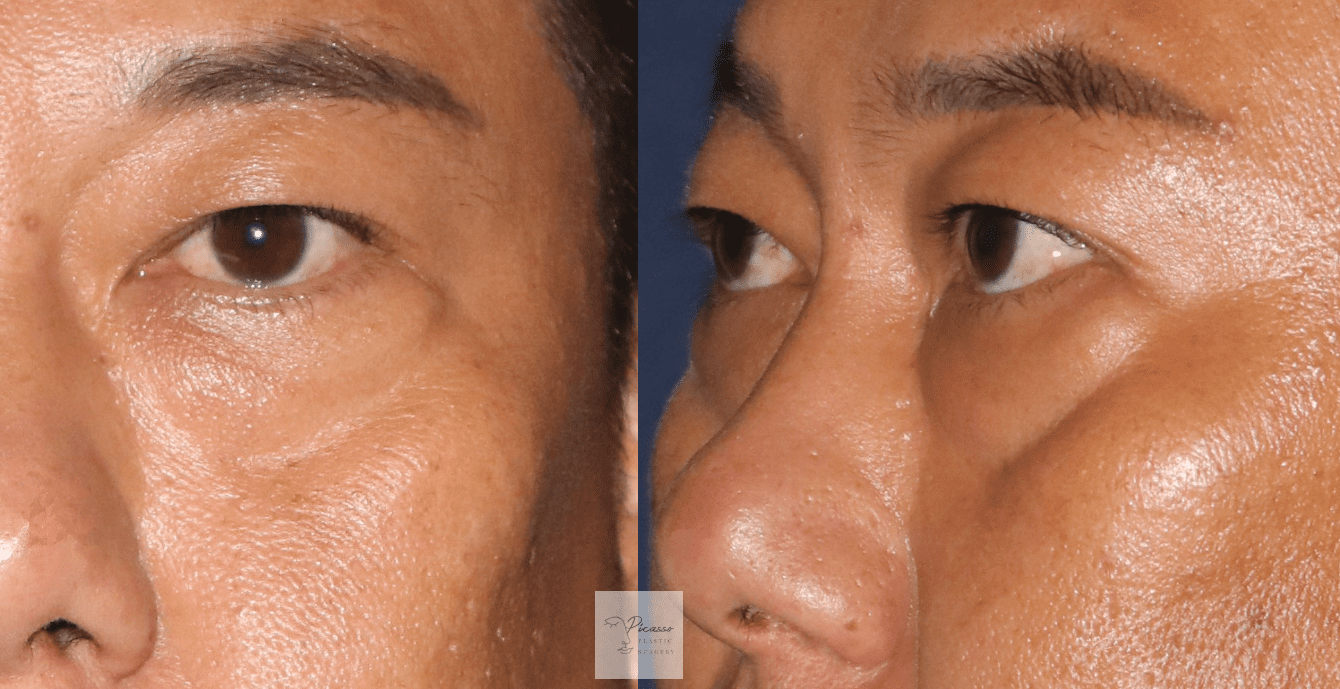
These include:
- Skin changes: loose lower eyelid skin with wrinkle formation that are especially visible when smiling, and dark circles
- Exposure of the lower white portion of the eye (sclera), due to loss of orbicularis muscle tone
- Eyebags, which are puffy fat protrusions that lie just below the eye sockets
- Formation of tear troughs, a depression lying just below the eyebag
The Lower Eyelid Anatomy
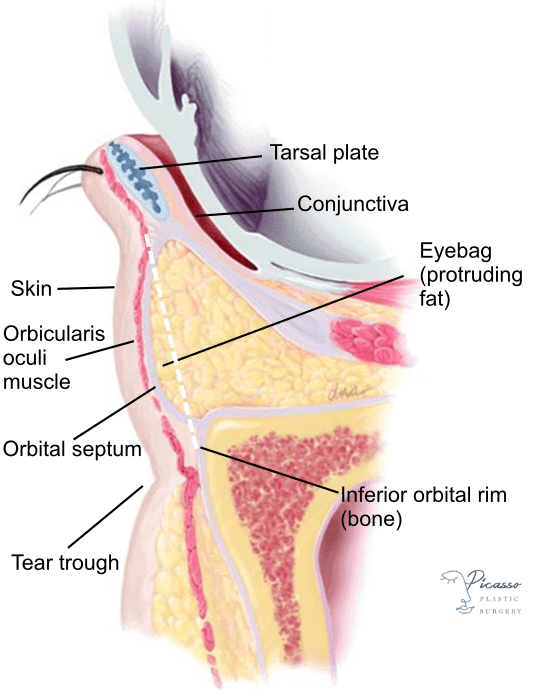
The lower eyelid is an anatomically delicate and complex structure that consists of three layers (lamellae).
- The outermost layer consists of lower eyelid skin (among the thinnest skin in the human body, 1 mm thick), and the orbicularis oculi muscle (responsible for blinking and eye closure)
- The middle layer consists of the orbital septum (a membrane that retains the eyebag fat within the eye socket). The septum thins with age, hence permitting the fat within the eye socket to protrude out and downwards, forming the eyebags.
- The inner layer consists of the tarsal plate (a piece of cartilage that maintains the eyelid support), and the conjunctiva, which covers the tarsal plate on the inner aspect of the eyelid
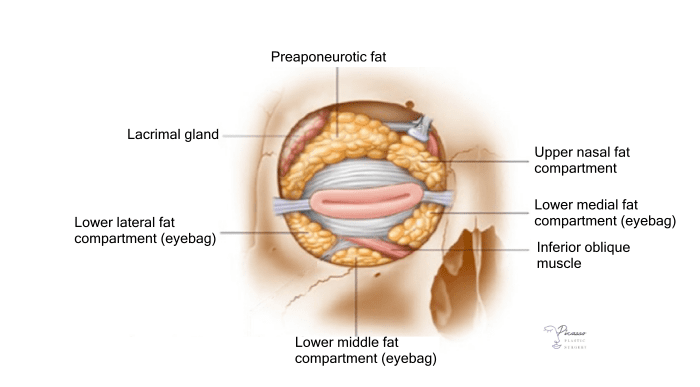
Within the eye socket (orbit), there are three lower fat compartments, the medial, middle and lateral fat compartments, that cushions the eyeball (globe). In youth, the septum holds the fat compartments within the eye socket. With advancing age, the septum becomes thin and loose, and the fat compartments bulge (herniate) in front of the eye socket, causing the appearance of eye bags.
Tear troughs are contour depressions that form below the eyebags. This is due to ligament attachments to the skin at the tear trough, and drooping of the skin, fat and muscle below this area of attachment.
How Is Eyebag Surgery Performed?
Eyebag surgery (“lower blepharoplasty”) rejuvenates the lower eyelids by removing excess skin, tightening the lower eyelid muscle, eliminating the eyebag bulge and filling the tear trough depression. The aim is to restore a smoother and refined contour between the eyes and the cheeks. High-quality lower blepharoplasty surgery does not apply a single surgical technique across all individuals. Instead, it is highly tailored to the individual’s eyes and targets the relevant component of eyelid aging, which differs from person to person. Surgery is performed as an ambulatory (day) case in our attached operating suite, under local anesthesia or with optional light sedation.
Where Are The Scars?
There are two different approaches to eyebag removal surgery.
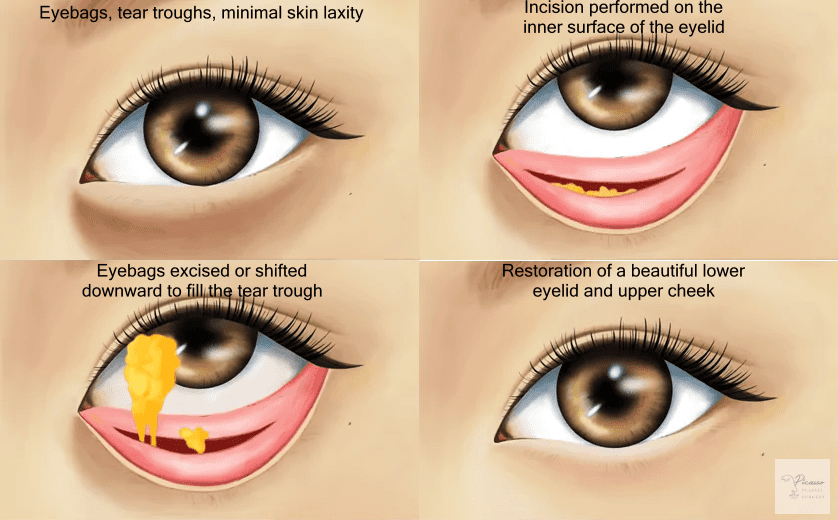
The transconjunctival lower blepharoplasty (inner approach) utilizes an incision on the inner surface of the eyelid (conjunctiva), and this has no visible external scar (“scarless” eyebag surgery). This technique is optimal in individuals with minimal skin and muscle laxity, and suitable for most people below 50.
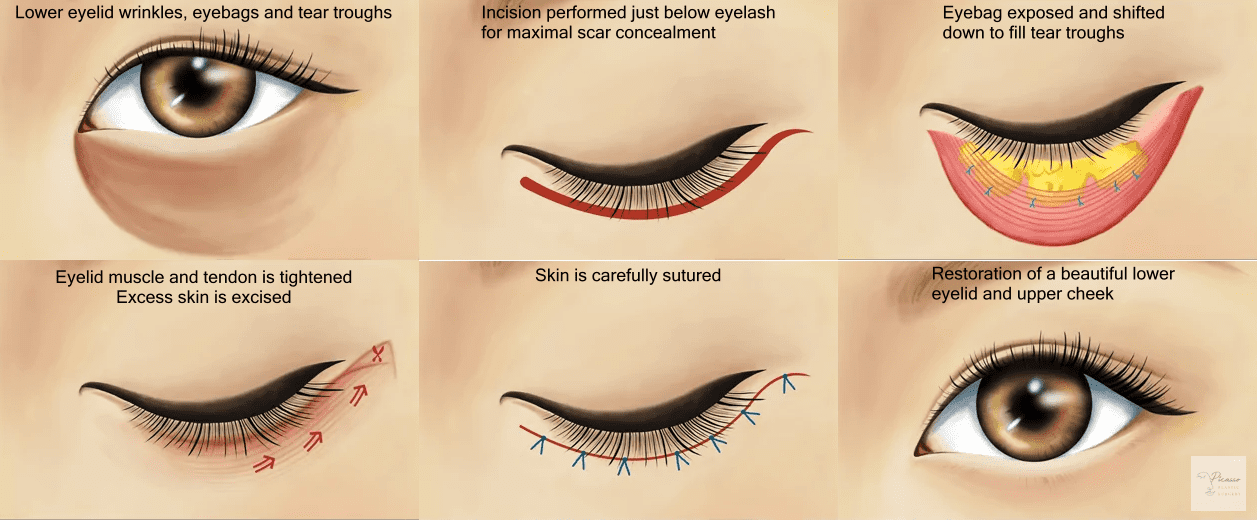
The transcutaneous lower blepharoplasty (external approach) utilizes an external skin incision that is done just beneath the lower eyelashes. This permits removal of excess skin and tightening of the lower eyelid muscle in appropriate cases.
With regard to the eyebag itself, it is completely excised in some cases, while in other cases, the eyebag may be shifted downwards to fill the depression caused by the tear trough. This reduces the eyebag protrusion and fills up the tear trough depression in one operation, and recreates the smooth convex contour running from the eyelashes down to the corner of the mouth.
How Should I Prepare For My Surgery?
Before the procedure
- Stop supplements and traditional medicine and start medications 7 days prior to surgery to minimise bruising and swelling
- Cessation of smoking for at least 2 weeks prior to surgery to minimise postoperative wound complications
- Minimize alcohol consumption 2 weeks prior to surgery to prevent accelerated clearance of medication from the body during and after the surgery.
On the day of the procedure
- Avoid wearing cosmetics and contact lenses
- Arrange for a taxi or private hire car for transport. Driving is to be avoided up to 24 hours post surgery due to the possible use of sedative medication.
- For cases performed under sedation, fasting of liquids and solid food is required 6 hours prior to surgery. For cases performed under local anesthesia, no fasting is required.
How Long Will My Recovery Be?
- First 48 hours. Swelling reduction is achieved by a combination of cold compresses, staying upright during the daytime, sleeping with slight head elevation, and regular consumption of anti-inflammatory medication. Avoid straining (heavy lifting, coughing) as these may cause postoperative bruising and bleeding. In most cases, oral tranexamic acid (a clotting medication) reduces postoperative bruising.
- Day 3 – 7. Warm compresses help to improve the blood supply to aid wound healing and clearance of bruising. Head elevation during sleep is advised until the swelling is mostly cleared. External skin stitches, if present, are removed on postoperative day 5 – 7, while inner conjunctival stitches are self-dissolving and do not require removal.
- Week 1 – 2. Return to work is often possible, and resumption of exercise is possible at the end of week 2. Most of the postoperative swelling and bruising would have resolved by the end of week 2.
- Week 4 – 6. Postoperative review is conducted in the clinic to evaluate the surgical result.
Other Associated Aging Changes in the Eyelid (Periorbital) Region
Aging changes in the eyelid region seldom occur in isolation. These may include droopy upper eyelids, which may be due to loose skin or loose muscle (or both), hollowing of the eye socket, crow’s feet and dark eye circles. Treatment of associated aging changes helps to produce a harmonious and beautiful postoperative result. Conversely, in many cases treatment of isolated aging changes may result in incomplete or unnatural outcomes. Our doctors are experienced in eyelid rejuvenation treatments and surgery and carefully evaluate each individual’s anatomy and existing pathology to recommend optimal treatment options to help you achieve your desired outcome.
Minimally-Invasive Treatments in the Lower Eyelid and Tear Trough Region
Younger patients with early aging changes in the lower eyelid region may be suitable for minimally-invasive treatments. These may include the use of botulinum toxin, fillers or structural fat grafting. Botulinum toxin injections reduce the action of the orbicularis oculi muscle and improve mild cases of lower eyelid wrinkles and crow’s feet. Early cases of eyebag and tear trough deformities, or loss of cheek fat volume, may be treated with filler injections or structural fat grafting. Individuals who are not suitable for minimally invasive treatments are those with skin loosening (multiple deep wrinkles), muscle laxity (lower eyelid descent causing the sclera to be shown), large eyebags or deep tear trough deformities.
Filler injections
- Filler injections with hyaluronic acid to the lower orbital rim are a quick-fix camouflage solution to reduce the prominence of eyebags by effacing the tear trough depression. It is suitable in younger patients with early eyebags, shallow tear troughs and minimal skin laxity.
- Filler injections in this region require experienced practitioners.
- The overlying skin and muscle is thin and there is risk of irregularity from uneven filler deposition
- There are multiple crucial nerves and blood vessels that should be avoided when delivering the filler injection
- Results from filler injections are immediate and last for 6 to 9 months and require repeat treatment
Structural Fat Grafting: The Gold Standard Minimally-Invasive Treatment
Fat grafting involves harvesting excess fat from the abdomen, thighs or hips and grafting it into areas of volume deficiency, such as the tear trough and cheeks. Furthermore, nanofat injections may be performed to areas of skin thinning and/or dark circles to improve wrinkles and pigmentation. This is a minimally-invasive procedure performed as an ambulatory day-surgery case. The fat is typically obtained through a small 2 – 3 mm incision and injected through 1 – 2 mm incisions in the volume deficient areas. Structural fat grafting is also often used during eyebag surgery to revolumize hollow areas such as the eye sockets and cheeks..
Am I Suitable For Structural Fat Grafting?
- Fat grafting as a standalone procedure is suitable for individuals with early eyebags and shallow tear troughs, and early volume deflation of the cheek. It is also suitable for injection into wrinkles in the form of nanofat. It offers a more natural and longer-lasting result than filler injections.
- Fat grafting is often combined with surgery to revolumize areas of age-related fat loss, including the temples, the cheeks and lower part of the eye socket. In cases with significant hollowing, structural fat grafting is more cost effective than treatment using large-volume filler injections.
- Individuals with stable weight are suitable for fat grafting; those who are losing weight or on weight loss medications are advised to await weight stabilization first, as this may affect the survival of grafted fat.
Will All The Grafted Fat Survive?
Fat grafts consist of adipocytes (fat cells) which require nutrients for their survival. Following the fat graft procedure, a process of neovascularization occurs in which new blood vessels grow into the area with grafted fat. This ensures the long term survival of the adipocytes. In most healthy individuals, the survival of grafted fat ranges between 60 to 80% and this is permanent. The remainder of fat is absorbed by the body. The final face contour is stable at about the second postoperative month.
Laser Treatments
Lasers stimulate skin thickening and reduce fine wrinkles in the lower eyelid region. There are other layers that help to reduce pigmentation and undereye dark circles. These usually require multiple treatments. While lasers do not reduce the size or prominence of eyebags themselves, they can effectively reduce the other associated signs of lower eyelid aging, brighten the under-eye area, creating a more radiant appearance.
The Picasso Plastic Surgery Advantage
The upper eyelid is anatomically complex and delicate. Successful outcomes demand accurate preoperative assessment, appropriate planning, precise execution, and meticulous postoperative care. Our Singapore board-certified surgeons are experienced in aesthetic and functional eyelid surgery and have a deep understanding of cultural aesthetic norms. Picasso Plastic Surgery also has European Board-certified plastic surgeons who are familiar with Western eyelid anatomy and related surgery. We carefully customise every procedure with precision and artistry to ensure natural, elegant outcomes that enhance each individual’s authentic beauty. Our clinic has an en-suite operating room that promises maximal comfort and privacy, and permits scheduling flexibility. Our surgeons are regarded for their work on eyelid surgery and frequently present their experience as invited faculty at international plastic surgery conferences and have written book chapters as well. Picasso Plastic Surgery has a strong reputation amongst peers and attracts regional and local plastic surgeon observers. Our highly trained support staff are attentive and skilled, and will partner you through your entire journey to attain a beautiful and bespoke outcome.
Start Your Journey
Call us at +65 62624140 or send us an email at enquiries@picassops.com to schedule an appointment.