

Quick Summary
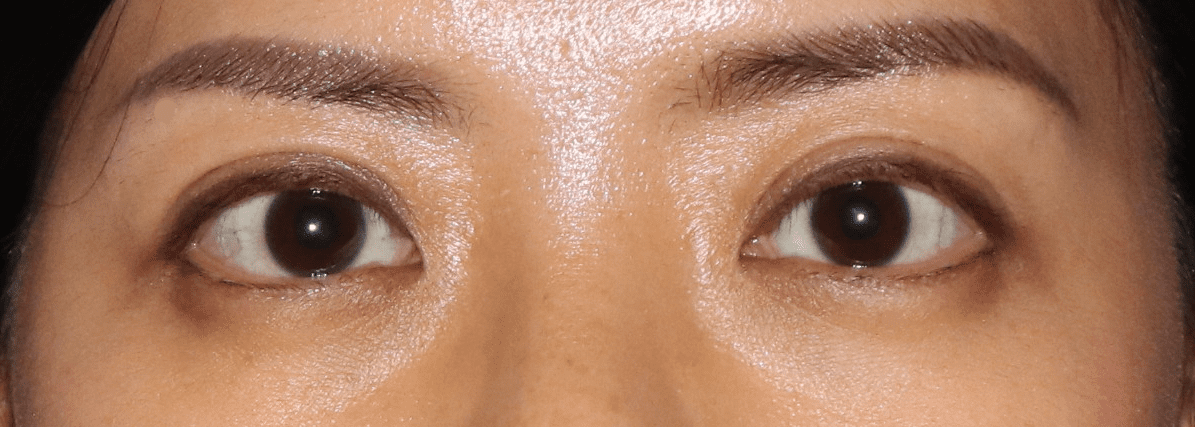
- The absence of a double eyelid crease (“single eyelid”) is common in some East Asian populations
- The cause of absent eyelid creases is the lack of attachments from the eyelid elevator muscle to the skin. This can be congenital, due to injury, or age-related
- Other associated functional problems may coexist, including loose upper eyelid skin (dermatochalasis), loose upper eyelid elevator muscle (ptosis) and abnormal skin folds on the inner side of the eyelid (epicanthal folds)
- Absent double eyelid creases are often associated with a tired, sleepy appearance with small eyes, and are perceived as unattractive. Individuals with double eyelid creases are often perceived as alert, bright and attractive
- There are different shapes of upper eyelid folds: the hidden fold, the tapered fold and the parallel fold
- There are two main types of crease creation double eyelid surgery: minimal-incisional (suture) and incisional double eyelid surgery, and two main methods of skin excision for accentuation of double creases
- Other complimentary procedures to improve the eyelid appearance may include eyelid skin removal (infrabrow excision, or skin-excision blepharoplasty), removal of the inner eyelid skin fold (medial epicanthoplasty), brow lift and fat grafting
The Upper Eyelid Aesthetic: A Brief History
The eyelids are the most visible part of the human anatomy. Studies have shown that we establish eye contact approximately 60% of the time during conversations. It is no surprise that humans have sought to beautify their eyelids since ancient times. Ancient Egyptians were known to put on makeup (dating back to ~4000BC) for aesthetic and religious purposes.
What Defines Beautiful Upper Eyelids: An Analysis
Beautiful youthful upper eyelids comprise of:
- Taut upper eyelid skin without wrinkles or droopiness, at rest and when smiling
- Appropriate vertical eye opening, not too big and not too small
- The approximate vertical height of an open eyelid ranges from 12 – 14 mm
- The MRD1 measurement (margin-to-reflex distance), which is distance from the center of the pupil to the lash line, is the other important measurement. This reflects the ability of the upper eyelid elevator muscle (levator palpebrae superioris, or LPS) to open the eye. The MRD1 measurement may be reduced in congenital cases, due to prior injury, chronic hard contact lens use, and age-related loosening. A MRD1 distance of < 4 mm usually denotes inadequate LPS muscle activity and manifests as droopiness or inability to fully open the eyes (“ptosis”), or small eyes.
- Pretarsal skin show. This is the skin lying just above the lash line below the double eyelid fold. A few factors affect the pretarsal skin show.
- Aging. In youth, the pretarsal skin show is 2 – 3 mm. As one ages, the upper eyelid skin elongates and the skin above the eyelid crease folds and droops over the eyelid crease, eventually covering the pretarsal skin show. Some individuals are born with “inner” creases with an upper eyelid skin fold that completely hides the pretarsal show and can be considered a normal appearance in some populations.
- Ethnicity. East Asians naturally have lower creases and less pretarsal skin show; Caucasians have moderately high creases and more pretarsal skin show, and Hispanics naturally have the highest creases and most pretarsal show
- Crisp, well-defined upper eyelid folds
- Minimal or absent inner eyelid skin (medial epicanthal) folds
- Normally positioned eyebrows. In women, eyebrows just above (0.5 – 1.0 cm) the eye socket (orbital rim); in men, eyebrows lie right at the eye socket
- Absence of eyelid hollowing (due to fat loss) or age-related fat protrusion
The Anatomy of a Double Eyelid Crease
The upper eyelid anatomy is delicate and complex. The eyelid consists of a few different layers (“lamella”) of tissue and are organized into the anterior, middle and posterior lamella.
- The anterior lamella consists of the upper eyelid skin and superficial muscle (orbicularis oculi). The upper eyelid skin is the thinnest skin in the body (0.5mm thickness) and is the first area to show aging
- The middle lamella consists of the cartilage (“tarsal plate”) and two layers of muscles, LPS muscle (eyelid elevator muscle) and the Mueller muscle. It is responsible for eyelid opening. The double eyelid crease is formed by attachments from the skin to the LPS muscle, which is found at the upper border of the tarsal plate
- The posterior lamella consists of the inner lining of the eyelid (“conjunctiva”), which contains mucous glands to lubricate the surface of the eye
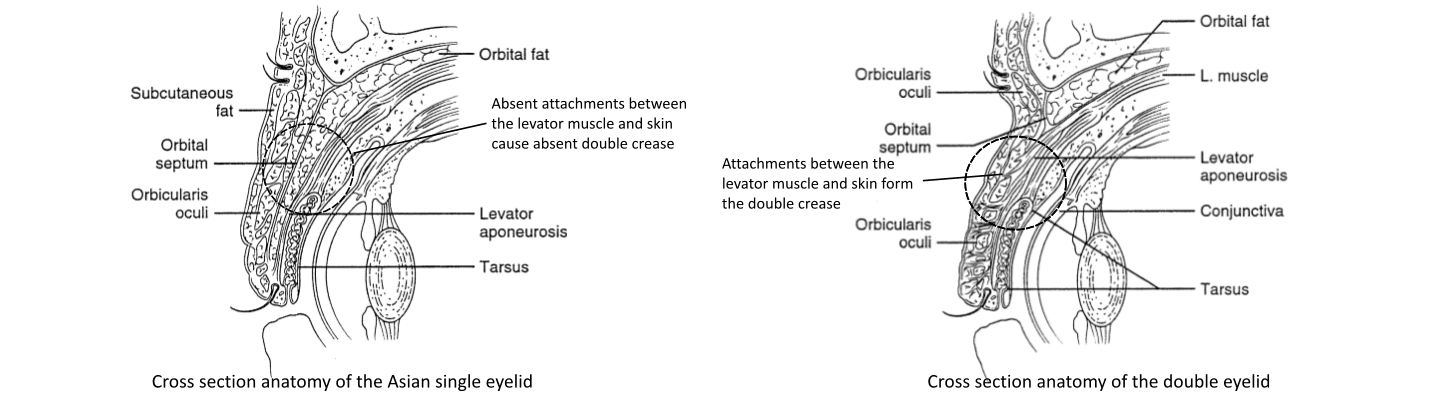
Individuals with absent double eyelid creases lack attachments from the LPS muscle to the skin. Double-eyelid surgery surgically creates this attachment between the muscle and the skin with sutures.
What Are The Different Types of Double Eyelid Crease?
Analysis of many hundreds of upper eyelids reveals some common morphologies. These include:
- Hidden fold. Such individuals have a well-formed crease, but the pretarsal skin show is completely covered by skin originating from above the upper eyelid crease. This is considered normal in some East Asian populations
- Tapered fold. Individuals with tapered folds have a narrower pretarsal skin width on the inner side of the upper eyelid, and gradually flares out towards the outer side of the eyelid. This is the most common type of upper eyelid double-crease in East Asian populations
- Parallel fold. Such individuals have a skin fold that is parallel to the eyelid margin and is constant in width from the inner to the outer side of the upper eyelid. This is the most common type of upper eyelid double crease in Caucasian and Hispanic populations
Ethnically Appropriate Eyelids
What do people mean when they request for “a natural appearance” during a consultation? Usually, this means that they wish to appear ethnically appropriate, and a youthful version of themselves. Younger East Asians who seek double eyelid surgery often want tapered folds, or less commonly, hidden folds. More mature East Asians who seek double eyelid surgery often wish to retain a tapered fold but remove droopy skin to accentuate the pretarsal skin width, to recreate a double-fold and a youthful appearance. Younger Caucasians and Hispanics usually do not require double-eyelid surgery; more mature individuals wish to remove droopy skin to increase the pretarsal skin width, to recreate a double-fold and a youthful appearance.
Is it possible to create Western creases in an Asian patient, and is it possible to create Asian creases in a Western patient? This is a technically complex question – the short answer is yes, but with certain limits, due to underlying anatomical constraints. It can be done, but infrequently so, to avoid unnatural results.
What is Double Eyelid Surgery and How Does It Work
The aim of double-eyelid surgery is to create a fold (if absent), and/or to unveil a fold that is hidden by age-related skin drooping.
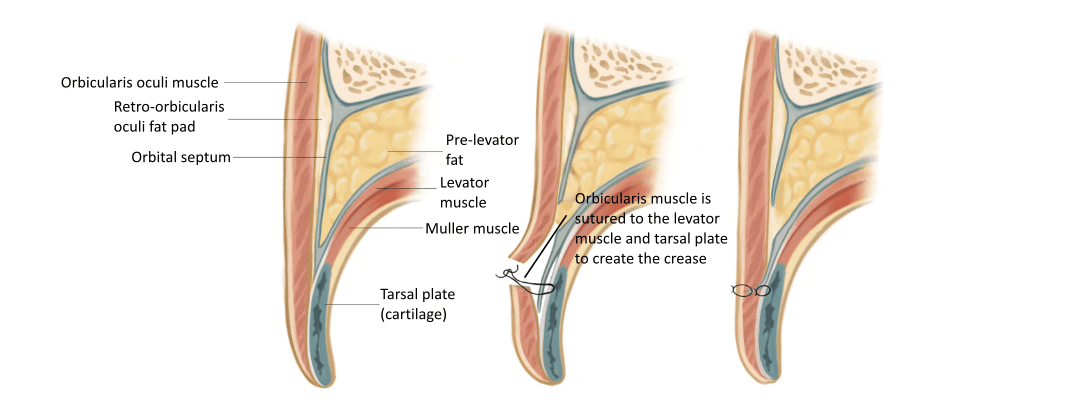
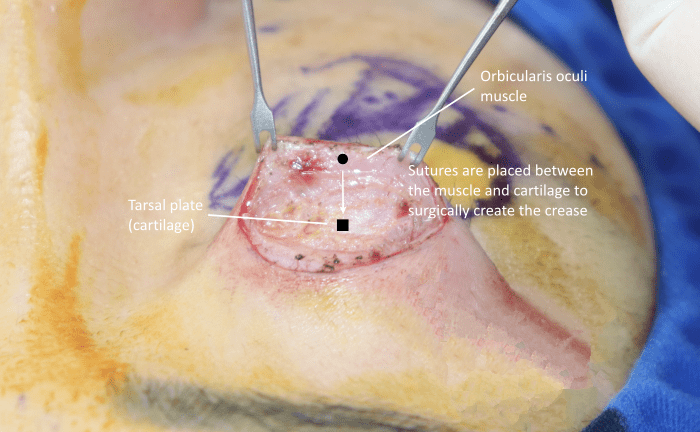
Eyelid crease creation is done by suturing the skin or superficial muscle to the underlying cartilage and/or the LPS muscle. Individuals with existing (hidden) creases who wish to reveal the pretarsal skin require excision of the upper eyelid skin to remove the excess, droopy skin that is covering the double eyelid (pretarsal) skin.
Surgeries are performed as ambulatory cases in our attached operating suite, under local anesthesia or with optional light sedation.
How Is The Double Eyelid Surgery Performed?
Double eyelid surgery may be classified into crease creation and crease accentuation procedures.
Crease creation procedures are divided into minimal-incision “suture” techniques, and open-incision double eyelid techniques.
- Minimal-incision surgery. Three to 5 small incisions are made along the planned double eyelid crease and sutures are passed between the skin/superficial muscle, through the cartilage and conjunctiva, and back to the skin/superficial muscle. Minimal incision techniques are associated with slightly faster recovery. However, a portion of cases lose the crease in the long-term due to suture breakage and may require secondary surgery for crease re-creation. Minimal-incision techniques are unable to remove droopy skin and are best suited for young individuals.
- Open-incision surgery. An incision is made along the crease, and sutures are placed between the superficial muscle and cartilage and/or LPS muscle under direct vision. This gives the most precise and enduring method of crease creation, and also permits excision of excess skin if required. Open-incision surgery is associated with slightly longer recovery than minimal-incision techniques.
Crease accentuation is achieved by skin excision through one of two ways:
- Upper eyelid crease incision. This is appropriate for individuals with mild/early skin laxity confined to the upper eyelid only. The upper eyelid crease incision is well-concealed but does not address skin laxity that is at the outer third of the upper eyelid, or outside of that.
- Infrabrow (or subbrow) incision. The incision is made at the lower border of the eyebrow and the excess upper eyelid skin is removed, and eyelid skin tightened by closing it up vertically. This incision addresses moderate-to-severe degrees of skin laxity, including loose skin that may be present outside of the upper eyelid.
Which is the Appropriate Procedure for You?
- Younger individuals with no loose skin are suited for minimal-incision techniques
- Individuals in their 30s and beyond may have a combination of factors causing loss of crease, including upper eyelid muscle (LPS) laxity (“ptosis”) and skin laxity (“dermatochalasis”) and require open incision techniques permitting muscle repair, and sometimes combined with infrabrow excision
- Open-incision techniques are favored for individuals seeking better long-term crease endurance
Addressing Asymmetry
The vast majority of individuals have some degree of asymmetry between the upper eyelids; very few of us are born with perfect symmetry. The presence of asymmetry often indicates underlying anatomical differences between both sides. Pre-operative evaluation of asymmetry and their cause(s) are important, and to assess if they can be corrected. Appropriate planning by your surgeon will help reduce the possibility and the degree of postoperative asymmetry.
What Is The Recovery Process Like?
- First 48 hours. Swelling reduction is achieved by a combination of cold compresses, staying upright and sleeping with slight head elevation, and regular consumption of anti-inflammatory medication. Avoid straining (heavy lifting, coughing) as these may cause postoperative bruising and bleeding. Consumption of tranexamic acid (a clotting medication) in most cases helps to reduce postoperative bruising
- Day 3 – 7. Warm compresses help to improve the blood supply to aid wound healing and clearance of bruising. Head elevation during sleep is advised until the swelling is mostly cleared. Stitches are usually removed on postoperative day 5 – 7
- Week 1 – 2. Return to work is often possible, and resumption of exercise is possible at the end of week 2
- Week 4 – 6. Most of the postoperative swelling would have resolved by this time and a postoperative evaluation in clinic is usually performed at this time to assess the result of the surgery
- Avoid vigorous eye rubbing as this may cause inner suture breakage and loss of crease
Complementary Procedures
Co-existing conditions are not uncommon, especially in older individuals. A careful pre-operative evaluation will help ascertain the presence of these conditions and gives the opportunity for correction during the same surgery. These include:
- Inner eyelid (medial epicanthal) skin folds, corrected by medial epicanthoplasty surgery
- Droopy upper eyelid muscle (LPS) (“ptosis”), corrected by levator tightening surgery. Ptosis surgery has functional benefits by reducing eye strain and improving the field of vision
- Hollowing of the eye sockets due to age-related fat loss, corrected by fat grafting surgery
- Droopy or low-positioned eyebrows, corrected by browlift surgery
Non-Surgical Alternatives
- Eyelid tape or glue. These are common non-permanent methods of creating a double crease. They are quick to perform. However, eyelid tape is visible when the eyelids are closed. Both tape and glue may be unsuitable in individuals with skin sensitivity to adhesives
- Makeup techniques. The use of eyeshadow or eyeliner may create the appearance of a double crease. However, this takes skill and time to perform and is temporary.
The Picasso Plastic Surgery Advantage
The upper eyelid is anatomically complex and delicate. Successful outcomes demand accurate preoperative assessment, appropriate planning, precise execution, and meticulous postoperative care. Our Singapore board-certified surgeons are experienced in aesthetic and functional eyelid surgery and have a deep understanding of cultural aesthetic norms. Picasso Plastic Surgery also has European Board-certified plastic surgeons who are familiar with Western eyelid anatomy and related surgery. We carefully customize every procedure with precision and artistry to ensure natural, elegant outcomes that enhance each individual’s authentic beauty. Our clinic has an en-suite operating room that promises maximal comfort and privacy, and permits scheduling flexibility. Our surgeons are regarded for their work on eyelid surgery and frequently present their experience as invited faculty at international plastic surgery conferences and have written book chapters as well. Picasso Plastic Surgery has a strong reputation amongst peers and attracts regional and local plastic surgeon observers. Our highly trained support staff are attentive and skilled, and will partner you through your entire journey to attain a beautiful and bespoke outcome.
Start Your Journey
Call us at +65 62624140 or send us an email at enquiries@picassops.com to schedule an appointment.